The Bead Society of Los Angeles has announced their
Fall Bead Bazaar
Sunday, October 25, 2009, 10 am to 5 pm at
Veteran's Memorial Auditorium
4117 Overland Ave,
corner of Culver Blvd., Culver City CA
The admission is free and there will be ample parking.
Typically, the Bead Bazaars are held twice a year in April and October. Approximately 100 vendors sell at each Bazaar. These events have become famous in Southern California. A huge variety of antique and contemporary beads, beaded objects, findings, etc., can be purchased there. The bazaar is a successful fundraiser for the Bead Society of Los Angeles.
The Oldest Bead Society in the US
The Bead Society of Los Angeles was founded in 1975 by an enthusiastic group of bead collectors, jewelry designers, importers and scholars. A wealth of old trade beads and ethnic jewelry was being brought into Los Angeles from countries around the world in this period. Because so little information about beads existed at the time, the founders felt the need to share their research and study as well as having the opportunity to show their collections and ideas. Soon membership was opened to others interested in beads and The Bead Society quickly grew. The same is true today, society members still meet and share their ideas and knowledge at the monthly meetings.
Jul 30, 2009


Jul 17, 2009
Spectacular Contemporary Jewelry from Peru!
Twitter has been an incredible community and means to meet fabulously talented jewelry and bead artist from across the globe. In the last three months, I have had the great fortune of having over 600 hundred people follow my tweets and my blog.
Pilar and Aldo are two very talented and artistic crafts people haling from Lima, Peru.
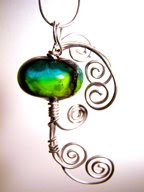
When I saw their work, I was thrilled with its uniqueness, and implored to write to them and ask them if I could feature their work on my blog. They were very happy to fulfill my request. So, here for the first time on this blog is just a few samples of their work. Please enjoy and don’t be shy to look at the other links that they have offered.
Pilar and Aldo are a happy couple that enjoy making and creating jewelry objects inspired by music, books and battles that cannot be found on maps but in the gifts of the wind.
Pilar works in Special Education and she studied Silver Crochet with the sculpture artist Juan Pacheco at Escultorica in her hometown Lima, Peru. Here is the site www.escultorica.com. In Canada, she took some courses in flaming glass. Her inspiration is based in the cosmos, the earth and the sea.
Aldo is an electronic engineer and also jeweler. He graduated from the Instituto Peruano de Joyeria y Arte, Escuela de Joyeria in his hometown of Lima. Here is their site address www.iperjoy.com. He also participated as an artist in the Patronato de Plata del Peru contest in 2006, www.patronatoplatadelperu.org. Aldo, also took courses in flaming and fused glass.
Both, Aldo and Pilar believe that there are simple things around us that make us happy. Those things are the gifts of the wind, like the dance of the leaves, the laughter of children playing, the smell of freshly baked bread...
M.Aldito.Arte / Aldo + Pilar
malditoarte@rogers.com
http://malditoarte.blogspot.com
www.malditoarte.etsy.com
Pilar and Aldo are two very talented and artistic crafts people haling from Lima, Peru.
When I saw their work, I was thrilled with its uniqueness, and implored to write to them and ask them if I could feature their work on my blog. They were very happy to fulfill my request. So, here for the first time on this blog is just a few samples of their work. Please enjoy and don’t be shy to look at the other links that they have offered.
Pilar and Aldo are a happy couple that enjoy making and creating jewelry objects inspired by music, books and battles that cannot be found on maps but in the gifts of the wind.
Pilar works in Special Education and she studied Silver Crochet with the sculpture artist Juan Pacheco at Escultorica in her hometown Lima, Peru. Here is the site www.escultorica.com. In Canada, she took some courses in flaming glass. Her inspiration is based in the cosmos, the earth and the sea.
Aldo is an electronic engineer and also jeweler. He graduated from the Instituto Peruano de Joyeria y Arte, Escuela de Joyeria in his hometown of Lima. Here is their site address www.iperjoy.com. He also participated as an artist in the Patronato de Plata del Peru contest in 2006, www.patronatoplatadelperu.org. Aldo, also took courses in flaming and fused glass.
Both, Aldo and Pilar believe that there are simple things around us that make us happy. Those things are the gifts of the wind, like the dance of the leaves, the laughter of children playing, the smell of freshly baked bread...
M.Aldito.Arte / Aldo + Pilar
malditoarte@rogers.com
http://malditoarte.blogspot.com
www.malditoarte.etsy.com
Jul 9, 2009
Man-made or Not?
I always believed that the “Strawberry Quartz” I was buying in the bead supply stores was truly quartz until I began research for this post. Low and behold--to my surprise, the "Strawberry Quartz" was actually not quartz at all. In fact it is really a unique form of glass created in China and India. It has a clear glass base with red or pink glass "hairs" swirled throughout the clear base.
The dishonest name was apparently invented by dealers. My question is…why the lie?? The material in and of itself is quite beautiful, the color unusual. I would have bought it if they called it glass.
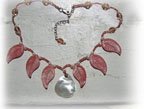
Be that as it may…I love the beads and found wonderful ways of pairing them with pearls and silver. I incorporated Czech high-fire polish faceted beads with the leaf bead necklace. The center of the necklace is Mother-of-Pearl. The leaf beads I found were on eBay.
There is nothing wrong with using glass beads…most beads are made of glass. I purchase glass beads all of the time. So, what was the problem? I also love gemstones, as well. A bit pricier, but worth the beauty.
The dishonest name was apparently invented by dealers. My question is…why the lie?? The material in and of itself is quite beautiful, the color unusual. I would have bought it if they called it glass.
Be that as it may…I love the beads and found wonderful ways of pairing them with pearls and silver. I incorporated Czech high-fire polish faceted beads with the leaf bead necklace. The center of the necklace is Mother-of-Pearl. The leaf beads I found were on eBay.
There is nothing wrong with using glass beads…most beads are made of glass. I purchase glass beads all of the time. So, what was the problem? I also love gemstones, as well. A bit pricier, but worth the beauty.
Jun 29, 2009
Philadelphia~The Largest Bead & Jewelry Show on the East Coast!
August 19-23, 2009
Valley Forge Convention Center
1160 First Avenue
King of Prussia, PA 19406
Montgomery County
Special Events
Friday, August 21
8:30 PM – 10:30 PM
Meet the Instructors Reception - Come and meet our world famous instructors! See what they are teaching and sign up for workshops. Instructors will also be selling kits, jewelry etc. Food & beverage served.
Free admission, cash bar available
Saturday, August 22
8 PM – 10 PM
Moonlight Bead In - Bring a project you are currently working on and get a chance to mingle with fellow beaders, Interweave Editors and Bead Fest staff!
Free and open to the public, cash bar available
Special Book Signings & jewelry-making demos by Interweave Authors
http://www.beadfest.com
Valley Forge Convention Center
1160 First Avenue
King of Prussia, PA 19406
Montgomery County
Special Events
Friday, August 21
8:30 PM – 10:30 PM
Meet the Instructors Reception - Come and meet our world famous instructors! See what they are teaching and sign up for workshops. Instructors will also be selling kits, jewelry etc. Food & beverage served.
Free admission, cash bar available
Saturday, August 22
8 PM – 10 PM
Moonlight Bead In - Bring a project you are currently working on and get a chance to mingle with fellow beaders, Interweave Editors and Bead Fest staff!
Free and open to the public, cash bar available
Special Book Signings & jewelry-making demos by Interweave Authors
http://www.beadfest.com
Jun 24, 2009
New England Bead Society~Presents
New England's oldest and best bead show at
the Armenian Cultural and Educational Center
The Bead Affaire on October 17th 2009
The Bead Affaire is held every fall, and features over fifty exhibitors from around the country, showing and selling an amazing range of beads, beading supplies and beaded jewelry. In addition to locally and nationally recognized glass bead artists and vendors, there are demonstrations and door prizes. The Bead Affaire offers both beginners and experienced beaders an opportunity to learn about beads, beading techniques and bead resources.
the Armenian Cultural and Educational Center
The Bead Affaire on October 17th 2009
The Bead Affaire is held every fall, and features over fifty exhibitors from around the country, showing and selling an amazing range of beads, beading supplies and beaded jewelry. In addition to locally and nationally recognized glass bead artists and vendors, there are demonstrations and door prizes. The Bead Affaire offers both beginners and experienced beaders an opportunity to learn about beads, beading techniques and bead resources.
Funds raised by the Bead Affaire are used to support the ongoing activities of the bead society including lectures, workshops and educational outreach projects.
http://www.beadesignerintl.org/
Jun 21, 2009
Beads at Harvard Sqaure ~ Cambridge
As a New Yorker, coming from the hectic fast-paced streets of the city, Harvard Square is like a breath of fresh air. Why? I have been visiting the Boston area for several years now because my close friends’ mother lives in a nearby location. Its relaxed beauty in which the Edwardian brick buildings of Harvard University that spread out over the area, as well as its many unique streets, shops and beautiful homes and history make it a stroller's paradise.
There are two shops both are on Church Street, a few doors apart. The first store is Cambridge Artists' Cooperative. I love to visit because I know that I will always find wonderful handmade and unique American items of the highest quality. They are largely created by New England artists and craftspeople. Their merchandise varies from paintings to framed stamps, from wearable items to truly amazing jewelry. The sales people are very friendly and open to chat about the store, the artists and life in general.
The wonderful thing about this store is that they are always open to new or not so new artists and designers. www.cambridgeartistscoop.com.
The other store in Cambridge is Beadworks, also on Church Street. This is a company that has a chain of several stores in different cities. What is really terrific about this store is that they cater to the hobbyist, to those new to beadwork and to the more experienced artisans. The store has great natural light provided by a beautiful skylight that creates an airy feeling. It is clearly laid out with their beads grouped by color. They offer classes and friendly assistance. I wish that we had a Beadworks Store in NYC (though there is one in Westchester). www.beadworkscambridge.com
I have included two necklaces that I created from the beads that I bought at Beadworks and one picture of the jewelry from the coop.
There are two shops both are on Church Street, a few doors apart. The first store is Cambridge Artists' Cooperative. I love to visit because I know that I will always find wonderful handmade and unique American items of the highest quality. They are largely created by New England artists and craftspeople. Their merchandise varies from paintings to framed stamps, from wearable items to truly amazing jewelry. The sales people are very friendly and open to chat about the store, the artists and life in general.
The wonderful thing about this store is that they are always open to new or not so new artists and designers. www.cambridgeartistscoop.com.
The other store in Cambridge is Beadworks, also on Church Street. This is a company that has a chain of several stores in different cities. What is really terrific about this store is that they cater to the hobbyist, to those new to beadwork and to the more experienced artisans. The store has great natural light provided by a beautiful skylight that creates an airy feeling. It is clearly laid out with their beads grouped by color. They offer classes and friendly assistance. I wish that we had a Beadworks Store in NYC (though there is one in Westchester). www.beadworkscambridge.com
I have included two necklaces that I created from the beads that I bought at Beadworks and one picture of the jewelry from the coop.
May 28, 2009
What's Coming Up Here in NYC
The best deal in town for every New York City and tri-state area beaders/jewelry artisans is the Bead Society of Greater New York. For a very small sum of $5.00 one can go to a meeting and learn something new, meet other wonderful artists, exchange ideas and generally have a great time.
They have scheduled a three day retrospective at the Fashion Institute of Technology
JUNE MEETING: WORLD OF BEADS VIII:
A 20 Year Retrospective
JUNE 19-21, 2009 at Fashion Institute of Technology’s Great Hall
It sounds really like something not to be missed...I myself will be there. They are calling for volunteers, if you are interested.
They have scheduled a three day retrospective at the Fashion Institute of Technology
JUNE MEETING: WORLD OF BEADS VIII:
A 20 Year Retrospective
JUNE 19-21, 2009 at Fashion Institute of Technology’s Great Hall
It sounds really like something not to be missed...I myself will be there. They are calling for volunteers, if you are interested.
May 27, 2009
The Lustrous Beauty of Czech Glass
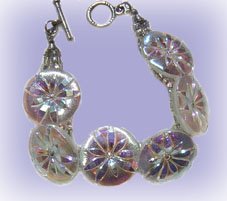
When did I fall in love with Czech Glass buttons? Actually it was during my search for Bakelite Buttons about three or more years ago. I discovered these buttons in sets of six, which was the perfect number for a bracelet because of their size; three-quarters of an inch. I was knocked off my feet by their beauty, iridescence, variety of patterns and lustrous color. They were gorgeous!
I knew that the Czech Republic was known for their manufacturing of glass high-fire polish beads, but was unaware at the time of their button manufacturing. Through my research, I found that they had a large number of factories producing the buttons for over 100 years. While purchasing these buttons I learned from the vendors that most of the factories had closed once WWII began. I assumed that the buttons that they were selling were coming from the stock left abandoned once the factory was closed. I thought the availability of these buttons was limited. Just recently in doing research for this post, I happily found that there are one or two factories still in operation, and that the 100- year old molds and the techniques for making these buttons are being used today. In a sense, these are vintage buttons that are being created today.
Only the Czechs make them. The quality is superb and even if they are a bit pricey it is well worth having them to incorporate them into your bracelet and necklace designs.
I found that these buttons come from a specific area called North Bohemia and is known as the "Glass Capital of The World", with a glass-making history dating back as far as 1376.
To make the bracelets and necklaces with these buttons, I use the same techniques to create my Bakelite button bracelets (please check previous post ). I can incorporate the buttons into necklaces using the same technique, also, explained in the post titled “The Joy of Vintage”.
With these buttons, because they are uniform in size, you can use the simpler technique using the elastic called Stretch Magic made by Pepperell Braiding Company. I use the .7 mm size. It is lighter, but just as strong as the next size up…but I am sure that it will go through all holes. For the connecting beads, I use a flat bead. Please check the photos for a view of the bead.
I have, for your convenience, added some sources for these magnificent buttons:
http://www.smarter.com, www.everyonelovesbuttons.com, http://www.abeadstore.com, http://www.joggles.com, http://www3.quantissimo.com
I knew that the Czech Republic was known for their manufacturing of glass high-fire polish beads, but was unaware at the time of their button manufacturing. Through my research, I found that they had a large number of factories producing the buttons for over 100 years. While purchasing these buttons I learned from the vendors that most of the factories had closed once WWII began. I assumed that the buttons that they were selling were coming from the stock left abandoned once the factory was closed. I thought the availability of these buttons was limited. Just recently in doing research for this post, I happily found that there are one or two factories still in operation, and that the 100- year old molds and the techniques for making these buttons are being used today. In a sense, these are vintage buttons that are being created today.
Only the Czechs make them. The quality is superb and even if they are a bit pricey it is well worth having them to incorporate them into your bracelet and necklace designs.
I found that these buttons come from a specific area called North Bohemia and is known as the "Glass Capital of The World", with a glass-making history dating back as far as 1376.
To make the bracelets and necklaces with these buttons, I use the same techniques to create my Bakelite button bracelets (please check previous post ). I can incorporate the buttons into necklaces using the same technique, also, explained in the post titled “The Joy of Vintage”.
With these buttons, because they are uniform in size, you can use the simpler technique using the elastic called Stretch Magic made by Pepperell Braiding Company. I use the .7 mm size. It is lighter, but just as strong as the next size up…but I am sure that it will go through all holes. For the connecting beads, I use a flat bead. Please check the photos for a view of the bead.
I have, for your convenience, added some sources for these magnificent buttons:
http://www.smarter.com, www.everyonelovesbuttons.com, http://www.abeadstore.com, http://www.joggles.com, http://www3.quantissimo.com
May 15, 2009
Bakelite…The Amazing Plastic of the Early 20th Century
What is the lure of Bakelite today? Why do people spend hundreds of dollars for a carved bangle bracelet, a pin, a necklace made from this first plastic invented c.1909 by Belgian inventor, Chemist L.H.Baekeland? I would say it is the lure of Vintage…owning something from a bygone period--and above all, the artisanship of the pieces.
Bakelite is the most well known of the earlier plastics, though people tend to lump all the early plastics under the title of Bakelite. The value of Bakelite is almost always higher than the other plastics. However, these other plastics are just as wonderful as Bakelite and have their value too. Parkesine (1862), Xylonite (1869), Celluloid (1869), Galalith (1897, aka Erinoid and French Bakelite), Bakelite (1909), Catalin (1927), and Lucite (1931, aka Plexiglas or Perspex). The first two, Parkesine and Xylonite, failed, but Galalith is still used today; primarily for making buttons. Lea Stein and Pavone are two recognized modern designers of French Bakelite Jewelry.
I fell in love with these wonderful early plastics in the form of buttons. To me they each were small pieces of sculpture. The questions were first of all, how to find the buttons at reasonable prices, and then how to assemble the buttons in a design that was fetching, beautiful and comfortable. My answer came to me with much experimentation. After time and great effort I had my product. Because of the construction of the button, its center of gravity being in the center, I felt that bracelets would be the best form for their use. I tried stretch elastic which is great for some designs, but not all. I finally came across the best solution for all types of buttons. Using small beads, 3-hole spacers and wire, I was able to construct a stylish bracelet for the buttons. Because I like the look of graduated sizes, I was also able to use a greater variety of buttons for each bracelet.
Mind you, the rare Bakelite button, the intricately carved buttons are very expensive, so cost-wise it made no sense. I picked a moderately-priced button or group of buttons, and I also incorporated other early plastics into some of the bracelets. The overall look is absolutely appealing--and never misses the eye of the customer. They are all also one-of-a-kind which is another appealing element!
Please take a look at the photos to see some samples.
I would like to continue for my next posting, Vintage glass buttons from the Czechoslovakian factories. Please keep an eye out.
Bakelite is the most well known of the earlier plastics, though people tend to lump all the early plastics under the title of Bakelite. The value of Bakelite is almost always higher than the other plastics. However, these other plastics are just as wonderful as Bakelite and have their value too. Parkesine (1862), Xylonite (1869), Celluloid (1869), Galalith (1897, aka Erinoid and French Bakelite), Bakelite (1909), Catalin (1927), and Lucite (1931, aka Plexiglas or Perspex). The first two, Parkesine and Xylonite, failed, but Galalith is still used today; primarily for making buttons. Lea Stein and Pavone are two recognized modern designers of French Bakelite Jewelry.
I fell in love with these wonderful early plastics in the form of buttons. To me they each were small pieces of sculpture. The questions were first of all, how to find the buttons at reasonable prices, and then how to assemble the buttons in a design that was fetching, beautiful and comfortable. My answer came to me with much experimentation. After time and great effort I had my product. Because of the construction of the button, its center of gravity being in the center, I felt that bracelets would be the best form for their use. I tried stretch elastic which is great for some designs, but not all. I finally came across the best solution for all types of buttons. Using small beads, 3-hole spacers and wire, I was able to construct a stylish bracelet for the buttons. Because I like the look of graduated sizes, I was also able to use a greater variety of buttons for each bracelet.
Mind you, the rare Bakelite button, the intricately carved buttons are very expensive, so cost-wise it made no sense. I picked a moderately-priced button or group of buttons, and I also incorporated other early plastics into some of the bracelets. The overall look is absolutely appealing--and never misses the eye of the customer. They are all also one-of-a-kind which is another appealing element!
Please take a look at the photos to see some samples.
I would like to continue for my next posting, Vintage glass buttons from the Czechoslovakian factories. Please keep an eye out.
Apr 2, 2009
The Joy of Vintage
Hello Everyone…I am back….
Vintage the fashion for today. Did you know that Carrie’s “Sex in the City” wardrobe consisted in a large part of vintage pieces found in the many NYC vintage and second hand stores?
One of my greatest pleasures is to browse and meander around antique and collectible stores, fairs, flea markets, tag sales and estate sales. What I am looking for is the odd piece that is in the jewelry “junk” pile. Many times, I have found that one-of-a-kind piece that will make a fabulous pendant. It might have been stickpin, but with a few adjustments with my tools it becomes a pendant. Or I could find an old necklace that is a bit dirty, but is made up of wonderful beads. I take it home cut the string, soak the beads in warm soapy water, dry them. They look like new and have that vintage feel. I then restring them, perhaps incorporating new beads. And voilá!! For just pennies I have created a beautiful new necklace without paying the price for new beads! The fun is in the search and find!
Don’t forget buttons…not only can they be used to make bracelets, they can also be incorporated into necklaces as well. You say how can that be done? Easy! Using memory wire and beads you can create a backing that will support the button so that it hangs flat on the necklace. This can be done with any button…so don’t be shy--use your buttons in your necklaces. In the sample I am showing with this article, I have used a Lucite, filigree, rhinestone button as a topper over the pendant. I incorporated onyx and rhinestone rondelles to really make it pop. I am including two other necklaces both using vintage, of course. The green is adorned with two Italian very old mille fiori…these beads are no longer made because the dye the bead makers were using were found to be toxic. Mille fiori beads are still made (mille fiori…meaning a thousand flowers), but using different dye and the newer ones just do not match the intensity if color. So, they were a great pleasure to find. The pink beaded necklace is from a circa 'fifties necklace. I took the old one apart, restrung it to this more updated version and incorporated some newer beads as well. The crystals are Swarovski and I got them for a song. I think I paid maybe three dollars for the original necklace.
Look for my next article…Bakelite and early plastic…what fun!
Vintage the fashion for today. Did you know that Carrie’s “Sex in the City” wardrobe consisted in a large part of vintage pieces found in the many NYC vintage and second hand stores?
One of my greatest pleasures is to browse and meander around antique and collectible stores, fairs, flea markets, tag sales and estate sales. What I am looking for is the odd piece that is in the jewelry “junk” pile. Many times, I have found that one-of-a-kind piece that will make a fabulous pendant. It might have been stickpin, but with a few adjustments with my tools it becomes a pendant. Or I could find an old necklace that is a bit dirty, but is made up of wonderful beads. I take it home cut the string, soak the beads in warm soapy water, dry them. They look like new and have that vintage feel. I then restring them, perhaps incorporating new beads. And voilá!! For just pennies I have created a beautiful new necklace without paying the price for new beads! The fun is in the search and find!
Don’t forget buttons…not only can they be used to make bracelets, they can also be incorporated into necklaces as well. You say how can that be done? Easy! Using memory wire and beads you can create a backing that will support the button so that it hangs flat on the necklace. This can be done with any button…so don’t be shy--use your buttons in your necklaces. In the sample I am showing with this article, I have used a Lucite, filigree, rhinestone button as a topper over the pendant. I incorporated onyx and rhinestone rondelles to really make it pop. I am including two other necklaces both using vintage, of course. The green is adorned with two Italian very old mille fiori…these beads are no longer made because the dye the bead makers were using were found to be toxic. Mille fiori beads are still made (mille fiori…meaning a thousand flowers), but using different dye and the newer ones just do not match the intensity if color. So, they were a great pleasure to find. The pink beaded necklace is from a circa 'fifties necklace. I took the old one apart, restrung it to this more updated version and incorporated some newer beads as well. The crystals are Swarovski and I got them for a song. I think I paid maybe three dollars for the original necklace.
Look for my next article…Bakelite and early plastic…what fun!
Jul 10, 2008
Fish Beads and Spirituality
Anne saw my blog and she wrote to me to ask me if I would feature her beads. After taking a look, I could not resist...they were beautiful. So I would like to share them with you and share her story as well.
Anne loves jewelry, but she doesn't wear a necklace because it goes with her shirt, or hair. She wears it to remind her of a truth. Each necklace is another truth she has learned, and clings to. The talisman around her neck soothes by its presence.
Anne made bird necklaces for twelve years, and now she makes lamp work glass fish wearable art. While she makes pendant necklaces and pearl necklaces with these fish, she finds the jewelry others make from her beads to be a greater spur to exploring new heights. Each trout or koi bead Anne holds in her hand inspires her to release her negativity, and allow the positive to flow into her. Native Americans believe the trout to be a sign of the presence of healing waters.
The trout and char she credits to the influence of her deceased grandfather. He accompanied her on many fishing trips, on the lakes and rivers of South Dakota. There is a magical quality to childhood memories, and a part of Anne lives on in that place, still fishing, smiling up from under a baseball cap. She is always striving to recreate in glass the sparkling life she caught on the end of her line, that emerged from the water like a living emerald.
While every fish is a unique result of flame, silver foil, and reduction glasses, each is created to reflect a specific species, local variety, and gender of North American Trout or Char.
Her company, Grama Tortoise Beads and Jewelry, is named after the mythical Grandmother Tortoise, whose gift of jewelry to a young woman helps the girl to recognize and achieve her potential power. To read the story, checkout Anne's website, www.GramaTortoise.com.
Jul 3, 2008
Blue Beauty
I want to talk about my friend and neighbor who has created many magnificent pieces, one of which I have featured here...that I call Blue Beauty. Linda is an incredible person who has the energy of 10 people. She is an entrepreneur and a whole foods chef, who owns and runs an organic foods market in my neighborhood with her husband. She is also a mother. She is an unusual person in that she truly cares about people, shows it every day in her interactions with them. I have never seen her in a bad mood, grumpy, or mean. She lives her spirituality.
With all that is on her plate, she managed to find beads and beading and has become an expert at her craft. She also gives classes. Each and every necklace produced by her hand truly reflects who she is. They are all beautiful and draw you in....you cannot stop looking at them.
Her work is intricate and time consuming....she tells me that she can work until 4 in the morning on her jewelry sometimes and then gets up to go to her store. I am always amazed at her passion for her work.
At some point, I would like to ask her some questions about what drew her to bead work and what it is that drives her to create these pieces. I would also like to show some more of her things. We just have to make a time, as I have said she is very busy.
Thank you for looking and keep posted.
Harriet
With all that is on her plate, she managed to find beads and beading and has become an expert at her craft. She also gives classes. Each and every necklace produced by her hand truly reflects who she is. They are all beautiful and draw you in....you cannot stop looking at them.
Her work is intricate and time consuming....she tells me that she can work until 4 in the morning on her jewelry sometimes and then gets up to go to her store. I am always amazed at her passion for her work.
At some point, I would like to ask her some questions about what drew her to bead work and what it is that drives her to create these pieces. I would also like to show some more of her things. We just have to make a time, as I have said she is very busy.
Thank you for looking and keep posted.
Harriet
May 14, 2008
Around the World

Hello Everyone….I hope all had a Happy Mother’s Day and found or made some magnificent pieces to give to their mothers'.
I would like to discuss a piece that I have completed that I call "Around the World”. I believe because beads come from every corner of the world throughout history that in some small way beading unites all of us.
This piece includes beads from Africa, China, Czechoslovakia, India, Japan and the U.S. The pendant bead is a Chinese wood carved bead. This type of bead would be the base bead for a cinnabar finish. The center of the bead is carved with the Chinese double-happiness sign. What a lovely thought for a gift.
The turquoise on the top and the two others on either side are from India.
Turquoise, the blue gemstone was worn by Pharaohs and Aztec Kings and is one of the oldest gemstones known. The name turquoise may have come from the word Turquie, French for Turkey, because of the early belief that the mineral came from that country (the turquoise most likely came from Alimersai).
In any case, the turquoise is found in mines across the world and historically prized by many. In our fashion today it is worn mostly in the summer, usually mounted with silver, reminding us of the Native American style. In the case of this necklace, I decided to pair it with earth colors because of the many veins found in these particular stones.
The small glass beads surrounding the bottom of the center turquoise are manufactured in Japan. They were strung on a memory wire and the wire was bent to shape the stone. The pendant is attached to the strung necklace by the wire and actually “swings” from the stone. Included in the rest of the necklace are carved wood beads from Africa. Ceramic beads from the U.S. and I end the necklace with multi-faceted high-fire polish beads from Czechoslovakia.
All in all, I feel that this necklace can circumnavigate the globe.
Thank you for looking and for your very appreciated comments. Keep them coming!
Apr 8, 2008
Springtime Events are Sprouting Up Everywhere!
For those of us in the Northeast, the cold weather has been told to go away, and grudgingly, it has finally gotten the message and left the building. Meanwhile Bead Society events and meetings are coming up like roses! The Bead Society of L.A. will be holding its phenomenal Spring Bead Bazaar in Culver City on Sunday, April 27, and any member can participate as a vendor. The New Mexico Bead Society will be holding its Mama's Day Beading Contest, so enter by April 16, and show 'em your stuff! In the Mile High City, the wonderfully active Rocky Mountain Bead Society will be holding its Bead Bazaar, at the Denver Merchandise Mart. This is a major event, which is not only an event for beaders, bead companies and gem vendors to display their artwork, but has numerous educational classes and seminars which jewelers and hobbyists can register for.
Mar 19, 2008
Cloisonné-enamelled Beads

These are the most colorful of the metal beads. They originate from China and are multi-colored.
Here are two of my creations using Cloisonné-enamelled beads and mixing them with Swarovski Crystal, vintage Murano glass and chain. All of these elements were purchased in two of my favorite stores in Manhattan…Beads World on Broadway and Bruce Frank Beads on the Upper West Side of Manhattan.
The first, is a star shaped pendant slide. The chain is adorned with six…five mm round Swarovski crystals. Added to that are smaller Swarovski crystals, bicone, in an asymmetrical pattern. The necklace measures 16” and closes with a lobster clasp.
The second, is a longer pendant chain. It not only is adorned with cloisonné beads but boasts of a multitude of glass beads from Czechoslovakia. The pendant is a vintage foil Murano glass bead, found at Bruce Frank Beads.
This necklace measures 28” including the pendant.
Next week, I will be showing wonderful mixtures of beads, so please keep looking.
Mar 12, 2008
A little bit about beads and their history
Since the beginning of human culture, beads have been part of the fabric of society. They have been discovered across the globe at archeological digs going back to prehistoric times.
Beads have not only been used throughout time to provide decoration, but to indicate wealth and status. They have been used to trade, and they have been used and are still being used for religious and ceremonial purposes.
To the Yoruba people of Nigeria, they are regarded as "ambassadors of heaven," their glow uniting heaven and earth. The Yoruba believe in their transformative powers and they are utilized by rulers, priests and diviners who manipulate power and divine forces. The word 'bead' comes from the Old English 'gebed' meaning 'prayer'.
Initially beads were made from shells, seeds and nuts. Over the years as man became more sophisticated and discovered more complex materials, beads have reflected mankind's cultural evolution. Today beads are made from numerous materials, and 90% of the bead industry beads are mass produced.
Most beads are made from glass, semi-precious stones, pearls, crystals, wood, bone, clay, ceramic, porcelain, lac, cloisonné, seeds, and shells and various metals. They are intricate in design and shape and include an enormous variation of colors.
Today, the bead industry itself has become huge. In the last eight years in New York City alone hobby bead stores have multiplied...where there were just a few, there are now dozens. Many people have discovered the joy of beads and beading: the lovers of beads, the crafters, the jewelry designers, the jewelry makers, the hobbyists and the bead artists are enjoying every minute of the process--from shopping for beads to creating magnificent pieces and one-of-a-kind jewelry.
Beads have not only been used throughout time to provide decoration, but to indicate wealth and status. They have been used to trade, and they have been used and are still being used for religious and ceremonial purposes.
To the Yoruba people of Nigeria, they are regarded as "ambassadors of heaven," their glow uniting heaven and earth. The Yoruba believe in their transformative powers and they are utilized by rulers, priests and diviners who manipulate power and divine forces. The word 'bead' comes from the Old English 'gebed' meaning 'prayer'.
Initially beads were made from shells, seeds and nuts. Over the years as man became more sophisticated and discovered more complex materials, beads have reflected mankind's cultural evolution. Today beads are made from numerous materials, and 90% of the bead industry beads are mass produced.
Most beads are made from glass, semi-precious stones, pearls, crystals, wood, bone, clay, ceramic, porcelain, lac, cloisonné, seeds, and shells and various metals. They are intricate in design and shape and include an enormous variation of colors.
Today, the bead industry itself has become huge. In the last eight years in New York City alone hobby bead stores have multiplied...where there were just a few, there are now dozens. Many people have discovered the joy of beads and beading: the lovers of beads, the crafters, the jewelry designers, the jewelry makers, the hobbyists and the bead artists are enjoying every minute of the process--from shopping for beads to creating magnificent pieces and one-of-a-kind jewelry.
Mar 7, 2008
Upcoming workshops held by The Bead Society of Greater New York
There is an ongoing series of Spring workshops that are being held by the Bead Society of Greater New York which are being taught by several of the most creative and accomplished bead artists and jewelers in the City. These workshops are held at the Fashion Institute of Technology, at West 27th Street and Seventh Avenue, and include such topics as "Photograph Your Beadwork, taught by Roberto Terrana, "Ootheca Cuff", taught by Rachel Nelson-Smith, and Russian Rose Necklace, taught by Ludmilla Raitzen, just to name three of the seven workshops. Advance your craft, network with other beaders, while enhancing your creativity!
"The BeadforLife Store eradicates extreme poverty by creating bridges of understanding between impoverished Africans and concerned world citizens. Ugandan women turn colorful recycled paper into beautiful beads, and people who care open their hearts, homes and communities to buy and sell the beads. . ."
"The BeadforLife Store eradicates extreme poverty by creating bridges of understanding between impoverished Africans and concerned world citizens. Ugandan women turn colorful recycled paper into beautiful beads, and people who care open their hearts, homes and communities to buy and sell the beads. . ."
Feb 29, 2008
News, products and resources for the bead artisan, jeweler and hobbyist
Welcome to this first entry in my Beaded Jewelry Gazette and Blog.
I am really excited about the fact that this unique resource will provide useful information and links to many of the best places to find the types of beads, tools and accessories that you need to create your beaded art and jewelry. Now and then, I will also discuss and show my own necklaces, bracelets and other jewelry that I have a strong passion for creating. Whenever there are events and meetings of bead societies, or articles that would be of interest to beaders, I'll make a point of posting them. If you have any events that bead artists want to know about, please contact me.
I am really excited about the fact that this unique resource will provide useful information and links to many of the best places to find the types of beads, tools and accessories that you need to create your beaded art and jewelry. Now and then, I will also discuss and show my own necklaces, bracelets and other jewelry that I have a strong passion for creating. Whenever there are events and meetings of bead societies, or articles that would be of interest to beaders, I'll make a point of posting them. If you have any events that bead artists want to know about, please contact me.
Subscribe to:
Posts (Atom)