What is the lure of Bakelite today? Why do people spend hundreds of dollars for a carved bangle bracelet, a pin, a necklace made from this first plastic invented c.1909 by Belgian inventor, Chemist L.H.Baekeland? I would say it is the lure of Vintage…owning something from a bygone period--and above all, the artisanship of the pieces.
Bakelite is the most well known of the earlier plastics, though people tend to lump all the early plastics under the title of Bakelite. The value of Bakelite is almost always higher than the other plastics. However, these other plastics are just as wonderful as Bakelite and have their value too. Parkesine (1862), Xylonite (1869), Celluloid (1869), Galalith (1897, aka Erinoid and French Bakelite), Bakelite (1909), Catalin (1927), and Lucite (1931, aka Plexiglas or Perspex). The first two, Parkesine and Xylonite, failed, but Galalith is still used today; primarily for making buttons. Lea Stein and Pavone are two recognized modern designers of French Bakelite Jewelry.
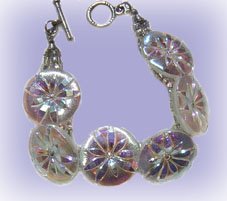
I fell in love with these wonderful early plastics in the form of buttons. To me they each were small pieces of sculpture. The questions were first of all, how to find the buttons at reasonable prices, and then how to assemble the buttons in a design that was fetching, beautiful and comfortable. My answer came to me with much experimentation. After time and great effort I had my product. Because of the construction of the button, its center of gravity being in the center, I felt that bracelets would be the best form for their use. I tried stretch elastic which is great for some designs, but not all. I finally came across the best solution for all types of buttons. Using small beads, 3-hole spacers and wire, I was able to construct a stylish bracelet for the buttons. Because I like the look of graduated sizes, I was also able to use a greater variety of buttons for each bracelet.
Mind you, the rare Bakelite button, the intricately carved buttons are very expensive, so cost-wise it made no sense. I picked a moderately-priced button or group of buttons, and I also incorporated other early plastics into some of the bracelets. The overall look is absolutely appealing--and never misses the eye of the customer. They are all also one-of-a-kind which is another appealing element!
Please take a look at the photos to see some samples.
I would like to continue for my next posting, Vintage glass buttons from the Czechoslovakian factories. Please keep an eye out.
Showing posts with label bakelite. Show all posts
Showing posts with label bakelite. Show all posts


Apr 2, 2009
The Joy of Vintage
Hello Everyone…I am back….
Vintage the fashion for today. Did you know that Carrie’s “Sex in the City” wardrobe consisted in a large part of vintage pieces found in the many NYC vintage and second hand stores?
One of my greatest pleasures is to browse and meander around antique and collectible stores, fairs, flea markets, tag sales and estate sales. What I am looking for is the odd piece that is in the jewelry “junk” pile. Many times, I have found that one-of-a-kind piece that will make a fabulous pendant. It might have been stickpin, but with a few adjustments with my tools it becomes a pendant. Or I could find an old necklace that is a bit dirty, but is made up of wonderful beads. I take it home cut the string, soak the beads in warm soapy water, dry them. They look like new and have that vintage feel. I then restring them, perhaps incorporating new beads. And voilá!! For just pennies I have created a beautiful new necklace without paying the price for new beads! The fun is in the search and find!
Don’t forget buttons…not only can they be used to make bracelets, they can also be incorporated into necklaces as well. You say how can that be done? Easy! Using memory wire and beads you can create a backing that will support the button so that it hangs flat on the necklace. This can be done with any button…so don’t be shy--use your buttons in your necklaces. In the sample I am showing with this article, I have used a Lucite, filigree, rhinestone button as a topper over the pendant. I incorporated onyx and rhinestone rondelles to really make it pop. I am including two other necklaces both using vintage, of course. The green is adorned with two Italian very old mille fiori…these beads are no longer made because the dye the bead makers were using were found to be toxic. Mille fiori beads are still made (mille fiori…meaning a thousand flowers), but using different dye and the newer ones just do not match the intensity if color. So, they were a great pleasure to find. The pink beaded necklace is from a circa 'fifties necklace. I took the old one apart, restrung it to this more updated version and incorporated some newer beads as well. The crystals are Swarovski and I got them for a song. I think I paid maybe three dollars for the original necklace.
Look for my next article…Bakelite and early plastic…what fun!
Vintage the fashion for today. Did you know that Carrie’s “Sex in the City” wardrobe consisted in a large part of vintage pieces found in the many NYC vintage and second hand stores?
One of my greatest pleasures is to browse and meander around antique and collectible stores, fairs, flea markets, tag sales and estate sales. What I am looking for is the odd piece that is in the jewelry “junk” pile. Many times, I have found that one-of-a-kind piece that will make a fabulous pendant. It might have been stickpin, but with a few adjustments with my tools it becomes a pendant. Or I could find an old necklace that is a bit dirty, but is made up of wonderful beads. I take it home cut the string, soak the beads in warm soapy water, dry them. They look like new and have that vintage feel. I then restring them, perhaps incorporating new beads. And voilá!! For just pennies I have created a beautiful new necklace without paying the price for new beads! The fun is in the search and find!
Don’t forget buttons…not only can they be used to make bracelets, they can also be incorporated into necklaces as well. You say how can that be done? Easy! Using memory wire and beads you can create a backing that will support the button so that it hangs flat on the necklace. This can be done with any button…so don’t be shy--use your buttons in your necklaces. In the sample I am showing with this article, I have used a Lucite, filigree, rhinestone button as a topper over the pendant. I incorporated onyx and rhinestone rondelles to really make it pop. I am including two other necklaces both using vintage, of course. The green is adorned with two Italian very old mille fiori…these beads are no longer made because the dye the bead makers were using were found to be toxic. Mille fiori beads are still made (mille fiori…meaning a thousand flowers), but using different dye and the newer ones just do not match the intensity if color. So, they were a great pleasure to find. The pink beaded necklace is from a circa 'fifties necklace. I took the old one apart, restrung it to this more updated version and incorporated some newer beads as well. The crystals are Swarovski and I got them for a song. I think I paid maybe three dollars for the original necklace.
Look for my next article…Bakelite and early plastic…what fun!
Subscribe to:
Posts (Atom)