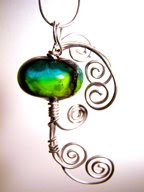
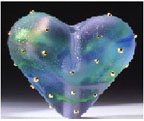
I always believed that the “Strawberry Quartz” I was buying in the bead supply stores was truly quartz until I began research for this post. Low and behold--to my surprise, the "Strawberry Quartz" was actually not quartz at all. In fact it is really a unique form of glass created in China and India. It has a clear glass base with red or pink glass "hairs" swirled throughout the clear base.
The dishonest name was apparently invented by dealers. My question is…why the lie?? The material in and of itself is quite beautiful, the color unusual. I would have bought it if they called it glass.
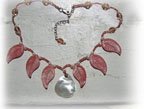
Be that as it may…I love the beads and found wonderful ways of pairing them with pearls and silver. I incorporated Czech high-fire polish faceted beads with the leaf bead necklace. The center of the necklace is Mother-of-Pearl. The leaf beads I found were on eBay.
There is nothing wrong with using glass beads…most beads are made of glass. I purchase glass beads all of the time. So, what was the problem? I also love gemstones, as well. A bit pricier, but worth the beauty.
Jul 9, 2009


Jun 29, 2009
Philadelphia~The Largest Bead & Jewelry Show on the East Coast!
August 19-23, 2009
Valley Forge Convention Center
1160 First Avenue
King of Prussia, PA 19406
Montgomery County
Special Events
Friday, August 21
8:30 PM – 10:30 PM
Meet the Instructors Reception - Come and meet our world famous instructors! See what they are teaching and sign up for workshops. Instructors will also be selling kits, jewelry etc. Food & beverage served.
Free admission, cash bar available
Saturday, August 22
8 PM – 10 PM
Moonlight Bead In - Bring a project you are currently working on and get a chance to mingle with fellow beaders, Interweave Editors and Bead Fest staff!
Free and open to the public, cash bar available
Special Book Signings & jewelry-making demos by Interweave Authors
http://www.beadfest.com
Valley Forge Convention Center
1160 First Avenue
King of Prussia, PA 19406
Montgomery County
Special Events
Friday, August 21
8:30 PM – 10:30 PM
Meet the Instructors Reception - Come and meet our world famous instructors! See what they are teaching and sign up for workshops. Instructors will also be selling kits, jewelry etc. Food & beverage served.
Free admission, cash bar available
Saturday, August 22
8 PM – 10 PM
Moonlight Bead In - Bring a project you are currently working on and get a chance to mingle with fellow beaders, Interweave Editors and Bead Fest staff!
Free and open to the public, cash bar available
Special Book Signings & jewelry-making demos by Interweave Authors
http://www.beadfest.com
Jun 24, 2009
New England Bead Society~Presents
New England's oldest and best bead show at
the Armenian Cultural and Educational Center
The Bead Affaire on October 17th 2009
The Bead Affaire is held every fall, and features over fifty exhibitors from around the country, showing and selling an amazing range of beads, beading supplies and beaded jewelry. In addition to locally and nationally recognized glass bead artists and vendors, there are demonstrations and door prizes. The Bead Affaire offers both beginners and experienced beaders an opportunity to learn about beads, beading techniques and bead resources.
the Armenian Cultural and Educational Center
The Bead Affaire on October 17th 2009
The Bead Affaire is held every fall, and features over fifty exhibitors from around the country, showing and selling an amazing range of beads, beading supplies and beaded jewelry. In addition to locally and nationally recognized glass bead artists and vendors, there are demonstrations and door prizes. The Bead Affaire offers both beginners and experienced beaders an opportunity to learn about beads, beading techniques and bead resources.
Funds raised by the Bead Affaire are used to support the ongoing activities of the bead society including lectures, workshops and educational outreach projects.
http://www.beadesignerintl.org/
Jun 21, 2009
Beads at Harvard Sqaure ~ Cambridge
As a New Yorker, coming from the hectic fast-paced streets of the city, Harvard Square is like a breath of fresh air. Why? I have been visiting the Boston area for several years now because my close friends’ mother lives in a nearby location. Its relaxed beauty in which the Edwardian brick buildings of Harvard University that spread out over the area, as well as its many unique streets, shops and beautiful homes and history make it a stroller's paradise.
There are two shops both are on Church Street, a few doors apart. The first store is Cambridge Artists' Cooperative. I love to visit because I know that I will always find wonderful handmade and unique American items of the highest quality. They are largely created by New England artists and craftspeople. Their merchandise varies from paintings to framed stamps, from wearable items to truly amazing jewelry. The sales people are very friendly and open to chat about the store, the artists and life in general.
The wonderful thing about this store is that they are always open to new or not so new artists and designers. www.cambridgeartistscoop.com.
The other store in Cambridge is Beadworks, also on Church Street. This is a company that has a chain of several stores in different cities. What is really terrific about this store is that they cater to the hobbyist, to those new to beadwork and to the more experienced artisans. The store has great natural light provided by a beautiful skylight that creates an airy feeling. It is clearly laid out with their beads grouped by color. They offer classes and friendly assistance. I wish that we had a Beadworks Store in NYC (though there is one in Westchester). www.beadworkscambridge.com
I have included two necklaces that I created from the beads that I bought at Beadworks and one picture of the jewelry from the coop.
There are two shops both are on Church Street, a few doors apart. The first store is Cambridge Artists' Cooperative. I love to visit because I know that I will always find wonderful handmade and unique American items of the highest quality. They are largely created by New England artists and craftspeople. Their merchandise varies from paintings to framed stamps, from wearable items to truly amazing jewelry. The sales people are very friendly and open to chat about the store, the artists and life in general.
The wonderful thing about this store is that they are always open to new or not so new artists and designers. www.cambridgeartistscoop.com.
The other store in Cambridge is Beadworks, also on Church Street. This is a company that has a chain of several stores in different cities. What is really terrific about this store is that they cater to the hobbyist, to those new to beadwork and to the more experienced artisans. The store has great natural light provided by a beautiful skylight that creates an airy feeling. It is clearly laid out with their beads grouped by color. They offer classes and friendly assistance. I wish that we had a Beadworks Store in NYC (though there is one in Westchester). www.beadworkscambridge.com
I have included two necklaces that I created from the beads that I bought at Beadworks and one picture of the jewelry from the coop.
May 28, 2009
What's Coming Up Here in NYC
The best deal in town for every New York City and tri-state area beaders/jewelry artisans is the Bead Society of Greater New York. For a very small sum of $5.00 one can go to a meeting and learn something new, meet other wonderful artists, exchange ideas and generally have a great time.
They have scheduled a three day retrospective at the Fashion Institute of Technology
JUNE MEETING: WORLD OF BEADS VIII:
A 20 Year Retrospective
JUNE 19-21, 2009 at Fashion Institute of Technology’s Great Hall
It sounds really like something not to be missed...I myself will be there. They are calling for volunteers, if you are interested.
They have scheduled a three day retrospective at the Fashion Institute of Technology
JUNE MEETING: WORLD OF BEADS VIII:
A 20 Year Retrospective
JUNE 19-21, 2009 at Fashion Institute of Technology’s Great Hall
It sounds really like something not to be missed...I myself will be there. They are calling for volunteers, if you are interested.
May 27, 2009
The Lustrous Beauty of Czech Glass
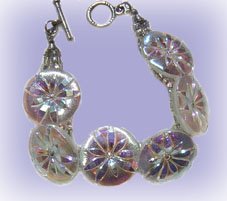
When did I fall in love with Czech Glass buttons? Actually it was during my search for Bakelite Buttons about three or more years ago. I discovered these buttons in sets of six, which was the perfect number for a bracelet because of their size; three-quarters of an inch. I was knocked off my feet by their beauty, iridescence, variety of patterns and lustrous color. They were gorgeous!
I knew that the Czech Republic was known for their manufacturing of glass high-fire polish beads, but was unaware at the time of their button manufacturing. Through my research, I found that they had a large number of factories producing the buttons for over 100 years. While purchasing these buttons I learned from the vendors that most of the factories had closed once WWII began. I assumed that the buttons that they were selling were coming from the stock left abandoned once the factory was closed. I thought the availability of these buttons was limited. Just recently in doing research for this post, I happily found that there are one or two factories still in operation, and that the 100- year old molds and the techniques for making these buttons are being used today. In a sense, these are vintage buttons that are being created today.
Only the Czechs make them. The quality is superb and even if they are a bit pricey it is well worth having them to incorporate them into your bracelet and necklace designs.
I found that these buttons come from a specific area called North Bohemia and is known as the "Glass Capital of The World", with a glass-making history dating back as far as 1376.
To make the bracelets and necklaces with these buttons, I use the same techniques to create my Bakelite button bracelets (please check previous post ). I can incorporate the buttons into necklaces using the same technique, also, explained in the post titled “The Joy of Vintage”.
With these buttons, because they are uniform in size, you can use the simpler technique using the elastic called Stretch Magic made by Pepperell Braiding Company. I use the .7 mm size. It is lighter, but just as strong as the next size up…but I am sure that it will go through all holes. For the connecting beads, I use a flat bead. Please check the photos for a view of the bead.
I have, for your convenience, added some sources for these magnificent buttons:
http://www.smarter.com, www.everyonelovesbuttons.com, http://www.abeadstore.com, http://www.joggles.com, http://www3.quantissimo.com
I knew that the Czech Republic was known for their manufacturing of glass high-fire polish beads, but was unaware at the time of their button manufacturing. Through my research, I found that they had a large number of factories producing the buttons for over 100 years. While purchasing these buttons I learned from the vendors that most of the factories had closed once WWII began. I assumed that the buttons that they were selling were coming from the stock left abandoned once the factory was closed. I thought the availability of these buttons was limited. Just recently in doing research for this post, I happily found that there are one or two factories still in operation, and that the 100- year old molds and the techniques for making these buttons are being used today. In a sense, these are vintage buttons that are being created today.
Only the Czechs make them. The quality is superb and even if they are a bit pricey it is well worth having them to incorporate them into your bracelet and necklace designs.
I found that these buttons come from a specific area called North Bohemia and is known as the "Glass Capital of The World", with a glass-making history dating back as far as 1376.
To make the bracelets and necklaces with these buttons, I use the same techniques to create my Bakelite button bracelets (please check previous post ). I can incorporate the buttons into necklaces using the same technique, also, explained in the post titled “The Joy of Vintage”.
With these buttons, because they are uniform in size, you can use the simpler technique using the elastic called Stretch Magic made by Pepperell Braiding Company. I use the .7 mm size. It is lighter, but just as strong as the next size up…but I am sure that it will go through all holes. For the connecting beads, I use a flat bead. Please check the photos for a view of the bead.
I have, for your convenience, added some sources for these magnificent buttons:
http://www.smarter.com, www.everyonelovesbuttons.com, http://www.abeadstore.com, http://www.joggles.com, http://www3.quantissimo.com
May 15, 2009
Bakelite…The Amazing Plastic of the Early 20th Century
What is the lure of Bakelite today? Why do people spend hundreds of dollars for a carved bangle bracelet, a pin, a necklace made from this first plastic invented c.1909 by Belgian inventor, Chemist L.H.Baekeland? I would say it is the lure of Vintage…owning something from a bygone period--and above all, the artisanship of the pieces.
Bakelite is the most well known of the earlier plastics, though people tend to lump all the early plastics under the title of Bakelite. The value of Bakelite is almost always higher than the other plastics. However, these other plastics are just as wonderful as Bakelite and have their value too. Parkesine (1862), Xylonite (1869), Celluloid (1869), Galalith (1897, aka Erinoid and French Bakelite), Bakelite (1909), Catalin (1927), and Lucite (1931, aka Plexiglas or Perspex). The first two, Parkesine and Xylonite, failed, but Galalith is still used today; primarily for making buttons. Lea Stein and Pavone are two recognized modern designers of French Bakelite Jewelry.
I fell in love with these wonderful early plastics in the form of buttons. To me they each were small pieces of sculpture. The questions were first of all, how to find the buttons at reasonable prices, and then how to assemble the buttons in a design that was fetching, beautiful and comfortable. My answer came to me with much experimentation. After time and great effort I had my product. Because of the construction of the button, its center of gravity being in the center, I felt that bracelets would be the best form for their use. I tried stretch elastic which is great for some designs, but not all. I finally came across the best solution for all types of buttons. Using small beads, 3-hole spacers and wire, I was able to construct a stylish bracelet for the buttons. Because I like the look of graduated sizes, I was also able to use a greater variety of buttons for each bracelet.
Mind you, the rare Bakelite button, the intricately carved buttons are very expensive, so cost-wise it made no sense. I picked a moderately-priced button or group of buttons, and I also incorporated other early plastics into some of the bracelets. The overall look is absolutely appealing--and never misses the eye of the customer. They are all also one-of-a-kind which is another appealing element!
Please take a look at the photos to see some samples.
I would like to continue for my next posting, Vintage glass buttons from the Czechoslovakian factories. Please keep an eye out.
Bakelite is the most well known of the earlier plastics, though people tend to lump all the early plastics under the title of Bakelite. The value of Bakelite is almost always higher than the other plastics. However, these other plastics are just as wonderful as Bakelite and have their value too. Parkesine (1862), Xylonite (1869), Celluloid (1869), Galalith (1897, aka Erinoid and French Bakelite), Bakelite (1909), Catalin (1927), and Lucite (1931, aka Plexiglas or Perspex). The first two, Parkesine and Xylonite, failed, but Galalith is still used today; primarily for making buttons. Lea Stein and Pavone are two recognized modern designers of French Bakelite Jewelry.
I fell in love with these wonderful early plastics in the form of buttons. To me they each were small pieces of sculpture. The questions were first of all, how to find the buttons at reasonable prices, and then how to assemble the buttons in a design that was fetching, beautiful and comfortable. My answer came to me with much experimentation. After time and great effort I had my product. Because of the construction of the button, its center of gravity being in the center, I felt that bracelets would be the best form for their use. I tried stretch elastic which is great for some designs, but not all. I finally came across the best solution for all types of buttons. Using small beads, 3-hole spacers and wire, I was able to construct a stylish bracelet for the buttons. Because I like the look of graduated sizes, I was also able to use a greater variety of buttons for each bracelet.
Mind you, the rare Bakelite button, the intricately carved buttons are very expensive, so cost-wise it made no sense. I picked a moderately-priced button or group of buttons, and I also incorporated other early plastics into some of the bracelets. The overall look is absolutely appealing--and never misses the eye of the customer. They are all also one-of-a-kind which is another appealing element!
Please take a look at the photos to see some samples.
I would like to continue for my next posting, Vintage glass buttons from the Czechoslovakian factories. Please keep an eye out.
Subscribe to:
Posts (Atom)