Hello Everyone…I am back….
Vintage the fashion for today. Did you know that Carrie’s “Sex in the City” wardrobe consisted in a large part of vintage pieces found in the many NYC vintage and second hand stores?
One of my greatest pleasures is to browse and meander around antique and collectible stores, fairs, flea markets, tag sales and estate sales. What I am looking for is the odd piece that is in the jewelry “junk” pile. Many times, I have found that one-of-a-kind piece that will make a fabulous pendant. It might have been stickpin, but with a few adjustments with my tools it becomes a pendant. Or I could find an old necklace that is a bit dirty, but is made up of wonderful beads. I take it home cut the string, soak the beads in warm soapy water, dry them. They look like new and have that vintage feel. I then restring them, perhaps incorporating new beads. And voilá!! For just pennies I have created a beautiful new necklace without paying the price for new beads! The fun is in the search and find!
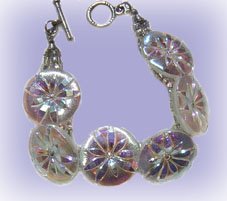
Don’t forget buttons…not only can they be used to make bracelets, they can also be incorporated into necklaces as well. You say how can that be done? Easy! Using memory wire and beads you can create a backing that will support the button so that it hangs flat on the necklace. This can be done with any button…so don’t be shy--use your buttons in your necklaces. In the sample I am showing with this article, I have used a Lucite, filigree, rhinestone button as a topper over the pendant. I incorporated onyx and rhinestone rondelles to really make it pop. I am including two other necklaces both using vintage, of course. The green is adorned with two Italian very old mille fiori…these beads are no longer made because the dye the bead makers were using were found to be toxic. Mille fiori beads are still made (mille fiori…meaning a thousand flowers), but using different dye and the newer ones just do not match the intensity if color. So, they were a great pleasure to find. The pink beaded necklace is from a circa 'fifties necklace. I took the old one apart, restrung it to this more updated version and incorporated some newer beads as well. The crystals are Swarovski and I got them for a song. I think I paid maybe three dollars for the original necklace.
Look for my next article…Bakelite and early plastic…what fun!
Apr 2, 2009


Jul 10, 2008
Fish Beads and Spirituality
Anne saw my blog and she wrote to me to ask me if I would feature her beads. After taking a look, I could not resist...they were beautiful. So I would like to share them with you and share her story as well.
Anne loves jewelry, but she doesn't wear a necklace because it goes with her shirt, or hair. She wears it to remind her of a truth. Each necklace is another truth she has learned, and clings to. The talisman around her neck soothes by its presence.
Anne made bird necklaces for twelve years, and now she makes lamp work glass fish wearable art. While she makes pendant necklaces and pearl necklaces with these fish, she finds the jewelry others make from her beads to be a greater spur to exploring new heights. Each trout or koi bead Anne holds in her hand inspires her to release her negativity, and allow the positive to flow into her. Native Americans believe the trout to be a sign of the presence of healing waters.
The trout and char she credits to the influence of her deceased grandfather. He accompanied her on many fishing trips, on the lakes and rivers of South Dakota. There is a magical quality to childhood memories, and a part of Anne lives on in that place, still fishing, smiling up from under a baseball cap. She is always striving to recreate in glass the sparkling life she caught on the end of her line, that emerged from the water like a living emerald.
While every fish is a unique result of flame, silver foil, and reduction glasses, each is created to reflect a specific species, local variety, and gender of North American Trout or Char.
Her company, Grama Tortoise Beads and Jewelry, is named after the mythical Grandmother Tortoise, whose gift of jewelry to a young woman helps the girl to recognize and achieve her potential power. To read the story, checkout Anne's website, www.GramaTortoise.com.
Jul 3, 2008
Blue Beauty
I want to talk about my friend and neighbor who has created many magnificent pieces, one of which I have featured here...that I call Blue Beauty. Linda is an incredible person who has the energy of 10 people. She is an entrepreneur and a whole foods chef, who owns and runs an organic foods market in my neighborhood with her husband. She is also a mother. She is an unusual person in that she truly cares about people, shows it every day in her interactions with them. I have never seen her in a bad mood, grumpy, or mean. She lives her spirituality.
With all that is on her plate, she managed to find beads and beading and has become an expert at her craft. She also gives classes. Each and every necklace produced by her hand truly reflects who she is. They are all beautiful and draw you in....you cannot stop looking at them.
Her work is intricate and time consuming....she tells me that she can work until 4 in the morning on her jewelry sometimes and then gets up to go to her store. I am always amazed at her passion for her work.
At some point, I would like to ask her some questions about what drew her to bead work and what it is that drives her to create these pieces. I would also like to show some more of her things. We just have to make a time, as I have said she is very busy.
Thank you for looking and keep posted.
Harriet
With all that is on her plate, she managed to find beads and beading and has become an expert at her craft. She also gives classes. Each and every necklace produced by her hand truly reflects who she is. They are all beautiful and draw you in....you cannot stop looking at them.
Her work is intricate and time consuming....she tells me that she can work until 4 in the morning on her jewelry sometimes and then gets up to go to her store. I am always amazed at her passion for her work.
At some point, I would like to ask her some questions about what drew her to bead work and what it is that drives her to create these pieces. I would also like to show some more of her things. We just have to make a time, as I have said she is very busy.
Thank you for looking and keep posted.
Harriet
May 14, 2008
Around the World

Hello Everyone….I hope all had a Happy Mother’s Day and found or made some magnificent pieces to give to their mothers'.
I would like to discuss a piece that I have completed that I call "Around the World”. I believe because beads come from every corner of the world throughout history that in some small way beading unites all of us.
This piece includes beads from Africa, China, Czechoslovakia, India, Japan and the U.S. The pendant bead is a Chinese wood carved bead. This type of bead would be the base bead for a cinnabar finish. The center of the bead is carved with the Chinese double-happiness sign. What a lovely thought for a gift.
The turquoise on the top and the two others on either side are from India.
Turquoise, the blue gemstone was worn by Pharaohs and Aztec Kings and is one of the oldest gemstones known. The name turquoise may have come from the word Turquie, French for Turkey, because of the early belief that the mineral came from that country (the turquoise most likely came from Alimersai).
In any case, the turquoise is found in mines across the world and historically prized by many. In our fashion today it is worn mostly in the summer, usually mounted with silver, reminding us of the Native American style. In the case of this necklace, I decided to pair it with earth colors because of the many veins found in these particular stones.
The small glass beads surrounding the bottom of the center turquoise are manufactured in Japan. They were strung on a memory wire and the wire was bent to shape the stone. The pendant is attached to the strung necklace by the wire and actually “swings” from the stone. Included in the rest of the necklace are carved wood beads from Africa. Ceramic beads from the U.S. and I end the necklace with multi-faceted high-fire polish beads from Czechoslovakia.
All in all, I feel that this necklace can circumnavigate the globe.
Thank you for looking and for your very appreciated comments. Keep them coming!
Apr 8, 2008
Springtime Events are Sprouting Up Everywhere!
For those of us in the Northeast, the cold weather has been told to go away, and grudgingly, it has finally gotten the message and left the building. Meanwhile Bead Society events and meetings are coming up like roses! The Bead Society of L.A. will be holding its phenomenal Spring Bead Bazaar in Culver City on Sunday, April 27, and any member can participate as a vendor. The New Mexico Bead Society will be holding its Mama's Day Beading Contest, so enter by April 16, and show 'em your stuff! In the Mile High City, the wonderfully active Rocky Mountain Bead Society will be holding its Bead Bazaar, at the Denver Merchandise Mart. This is a major event, which is not only an event for beaders, bead companies and gem vendors to display their artwork, but has numerous educational classes and seminars which jewelers and hobbyists can register for.
Mar 19, 2008
Cloisonné-enamelled Beads

These are the most colorful of the metal beads. They originate from China and are multi-colored.
Here are two of my creations using Cloisonné-enamelled beads and mixing them with Swarovski Crystal, vintage Murano glass and chain. All of these elements were purchased in two of my favorite stores in Manhattan…Beads World on Broadway and Bruce Frank Beads on the Upper West Side of Manhattan.
The first, is a star shaped pendant slide. The chain is adorned with six…five mm round Swarovski crystals. Added to that are smaller Swarovski crystals, bicone, in an asymmetrical pattern. The necklace measures 16” and closes with a lobster clasp.
The second, is a longer pendant chain. It not only is adorned with cloisonné beads but boasts of a multitude of glass beads from Czechoslovakia. The pendant is a vintage foil Murano glass bead, found at Bruce Frank Beads.
This necklace measures 28” including the pendant.
Next week, I will be showing wonderful mixtures of beads, so please keep looking.
Mar 12, 2008
A little bit about beads and their history
Since the beginning of human culture, beads have been part of the fabric of society. They have been discovered across the globe at archeological digs going back to prehistoric times.
Beads have not only been used throughout time to provide decoration, but to indicate wealth and status. They have been used to trade, and they have been used and are still being used for religious and ceremonial purposes.
To the Yoruba people of Nigeria, they are regarded as "ambassadors of heaven," their glow uniting heaven and earth. The Yoruba believe in their transformative powers and they are utilized by rulers, priests and diviners who manipulate power and divine forces. The word 'bead' comes from the Old English 'gebed' meaning 'prayer'.
Initially beads were made from shells, seeds and nuts. Over the years as man became more sophisticated and discovered more complex materials, beads have reflected mankind's cultural evolution. Today beads are made from numerous materials, and 90% of the bead industry beads are mass produced.
Most beads are made from glass, semi-precious stones, pearls, crystals, wood, bone, clay, ceramic, porcelain, lac, cloisonné, seeds, and shells and various metals. They are intricate in design and shape and include an enormous variation of colors.
Today, the bead industry itself has become huge. In the last eight years in New York City alone hobby bead stores have multiplied...where there were just a few, there are now dozens. Many people have discovered the joy of beads and beading: the lovers of beads, the crafters, the jewelry designers, the jewelry makers, the hobbyists and the bead artists are enjoying every minute of the process--from shopping for beads to creating magnificent pieces and one-of-a-kind jewelry.
Beads have not only been used throughout time to provide decoration, but to indicate wealth and status. They have been used to trade, and they have been used and are still being used for religious and ceremonial purposes.
To the Yoruba people of Nigeria, they are regarded as "ambassadors of heaven," their glow uniting heaven and earth. The Yoruba believe in their transformative powers and they are utilized by rulers, priests and diviners who manipulate power and divine forces. The word 'bead' comes from the Old English 'gebed' meaning 'prayer'.
Initially beads were made from shells, seeds and nuts. Over the years as man became more sophisticated and discovered more complex materials, beads have reflected mankind's cultural evolution. Today beads are made from numerous materials, and 90% of the bead industry beads are mass produced.
Most beads are made from glass, semi-precious stones, pearls, crystals, wood, bone, clay, ceramic, porcelain, lac, cloisonné, seeds, and shells and various metals. They are intricate in design and shape and include an enormous variation of colors.
Today, the bead industry itself has become huge. In the last eight years in New York City alone hobby bead stores have multiplied...where there were just a few, there are now dozens. Many people have discovered the joy of beads and beading: the lovers of beads, the crafters, the jewelry designers, the jewelry makers, the hobbyists and the bead artists are enjoying every minute of the process--from shopping for beads to creating magnificent pieces and one-of-a-kind jewelry.
Subscribe to:
Posts (Atom)